
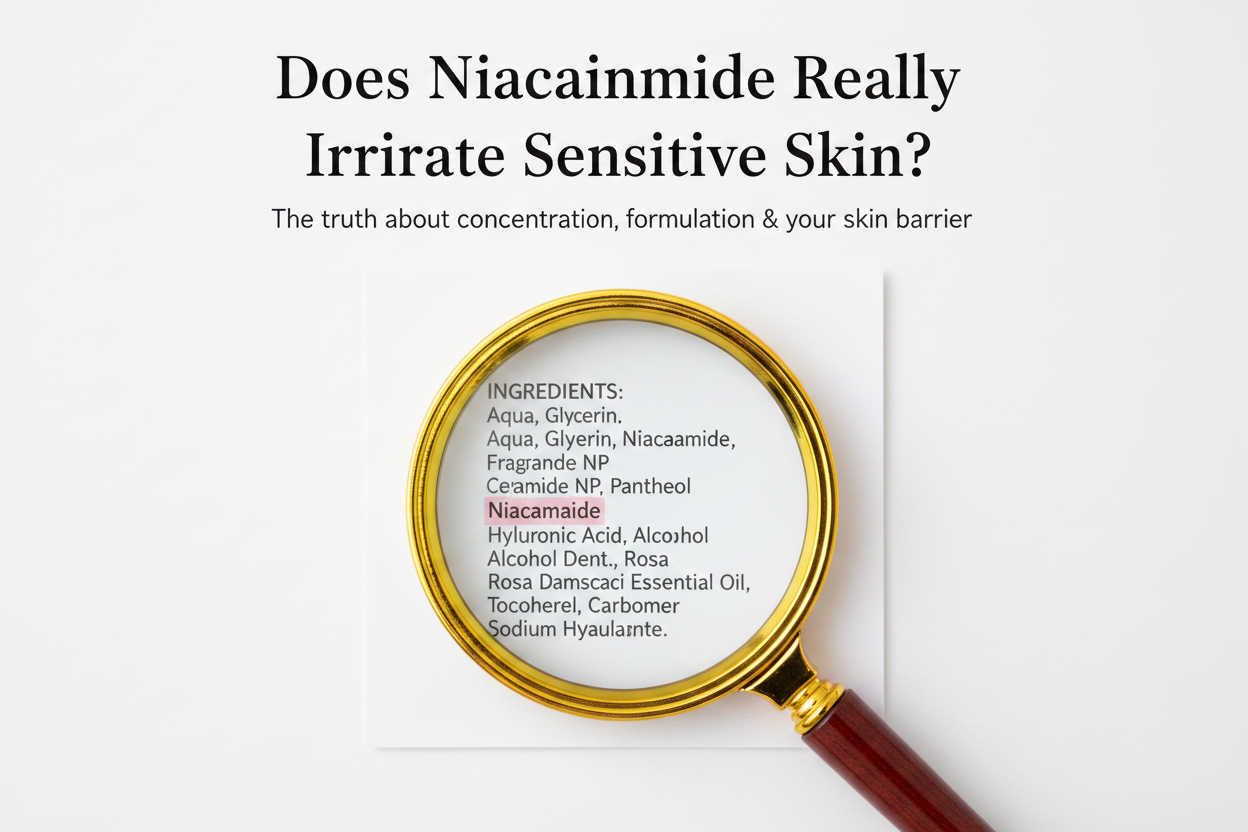
Does Niacinamide Really Irritate Sensitive Skin?
Niacinamide has become one of the most talked-about skincare ingredients in recent years. It’s recommended by dermatologists, found in countless serums and moisturisers, and praised for helping reduce redness, strengthen the skin barrier and improve hydration.
But if you’ve searched online, you’ve probably also seen people saying:
“Niacinamide ruined my skin.”
“I can’t use anything with niacinamide.”
“Every product with niacinamide burns.”
So, who’s right?
The answer isn’t as simple as blaming one ingredient. In many cases, niacinamide isn’t actually the problem.
What is niacinamide?
Niacinamide is a form of vitamin B3 that naturally occurs in the body. It plays an important role in maintaining healthy skin and is one of the most researched ingredients in skincare.
It’s one of the most well-researched skincare ingredients available, with studies showing it can help improve barrier function, reduce water loss and calm visible redness when used in appropriate concentrations.
When formulated well, niacinamide can help:
- Support the skin barrier
- Reduce moisture loss
- Improve hydration
- Calm visible redness
- Strengthen the skin over time
- Improve uneven skin tone
- Reduce excess oil production
For many people, it’s an excellent ingredient.
Why do some people react to niacinamide?
If your skin burns, stings or becomes red after using a product containing niacinamide, it doesn’t automatically mean niacinamide is the cause.
Several factors need to be considered.
1. The concentration may be too high
Many products now contain 10%, 15% or even 20% niacinamide because higher percentages sound more impressive.
Research has shown many of niacinamide’s skin barrier benefits at concentrations around 2–5%. That doesn’t mean higher concentrations are wrong—it simply means higher isn’t always better for every skin type.
For people with a compromised skin barrier or very reactive skin, high-strength niacinamide can sometimes be irritating.
2. The formula matters just as much
This is one of the biggest misconceptions in skincare.
One of the biggest mistakes I see is people blaming a single ingredient, when it’s rarely that simple. A skincare product is a combination of ingredients, and your skin reacts to the finished formula—not just one ingredient listed on the label.
A product may also contain:
- Fragrance
- Essential oils
- Drying alcohols
- Exfoliating acids
- Preservatives
- Multiple active ingredients layered together
Sometimes it’s one ingredient causing irritation. Sometimes it’s the combination of ingredients.
Any of these ingredients—or the combination of them—may be responsible for irritation.
It’s also important to remember that ingredients don’t work in isolation. The concentration of niacinamide, what it’s combined with, and the overall formulation all influence how your skin responds.
Niacinamide simply gets blamed because it’s the ingredient people recognise.
3. Your skin barrier may already be damaged
When the skin barrier is weakened, almost everything can sting.
I’ve seen people who couldn’t tolerate even the gentlest moisturiser until their skin barrier had time to recover.
Even products designed for sensitive skin can feel uncomfortable. When the skin barrier is compromised, the skin often becomes more reactive to products it previously tolerated.
This doesn’t necessarily mean you’re allergic to an ingredient. It often means your skin needs time to repair before it can tolerate active ingredients again.
Can someone genuinely be sensitive to niacinamide?
Yes.
Like any skincare ingredient, some people can be genuinely sensitive to niacinamide.
Every skin is different, and no ingredient is suitable for everyone.
However, true sensitivity appears to be far less common than people often believe.
In clinical practice, it’s not unusual to see someone who believes they’re reacting to niacinamide, when in reality their skin is responding to a damaged barrier, high concentrations, or other irritating ingredients in the product.
What should you do if niacinamide seems to irritate your skin?
Don’t force your skin to tolerate something that consistently causes discomfort.
Instead:
- Stop using multiple active products.
- Simplify your skincare routine.
- Focus on repairing your skin barrier.
- Introduce one product at a time.
- Patch test before applying to your entire face.
If irritation continues, consider seeing a dermatologist or healthcare professional. Persistent redness, burning or flushing can sometimes be associated with conditions such as rosacea, eczema or allergic contact dermatitis, which may require professional assessment.
My approach as a Dermal Therapist and Nurse
One of the biggest reasons I created Celulah Skin was because I kept seeing people with sensitive, reactive skin using products that contained long ingredient lists filled with unnecessary irritants.
Rather than chasing trends, I wanted to focus on supporting the skin barrier first.
That means choosing ingredients carefully, keeping formulations as gentle as possible, and avoiding unnecessary fragrance and essential oils that can trigger sensitive skin.
I don’t believe skincare should leave your skin feeling tight, burning or uncomfortable.
Healthy skin shouldn’t burn, sting or feel tight every day. Skin should feel comfortable.
The bottom line
Niacinamide isn’t the villain it’s sometimes made out to be.
For many people, it’s a beneficial ingredient that helps strengthen the skin barrier and reduce visible redness.
But concentration matters.
Formulation matters.
Most importantly, the condition of your skin barrier matters.
If your skin is reacting, don’t assume one ingredient is always to blame. Looking at the entire formula—and the health of your skin—often provides a much clearer answer.
Every skin is different
One of the biggest lessons I’ve learnt as a Dermal Therapist and Nurse is that there is no ingredient that suits everyone.
What works beautifully for one person may not work for another.
That’s why I believe it’s so important to understand your skin, rather than simply following trends or chasing the highest percentage of an ingredient.
Listening to your skin will always tell you more than a marketing label.
My final thoughts
One ingredient rarely tells the whole story.
If your skin burns, stings or reacts to almost everything, don’t assume you’ve suddenly become allergic to every skincare ingredient. Sometimes the real issue is a damaged skin barrier or a formula that simply isn’t right for your skin.
Sometimes the answer isn’t adding another active ingredient—it’s giving your skin the opportunity to recover.
As both a Dermal Therapist and Nurse, my goal has always been to help people understand their skin—not overwhelm it.
That’s why I created Celulah Skin.
Not to create skincare that follows trends, but to create formulations that put skin comfort first.
Because healthy skin shouldn’t just look good.
It should feel good.
With care,
Nicole Phillips
Founder | Dermal Therapist | Nurse
Celulah Skin


Leave a comment
This site is protected by hCaptcha and the hCaptcha Privacy Policy and Terms of Service apply.