
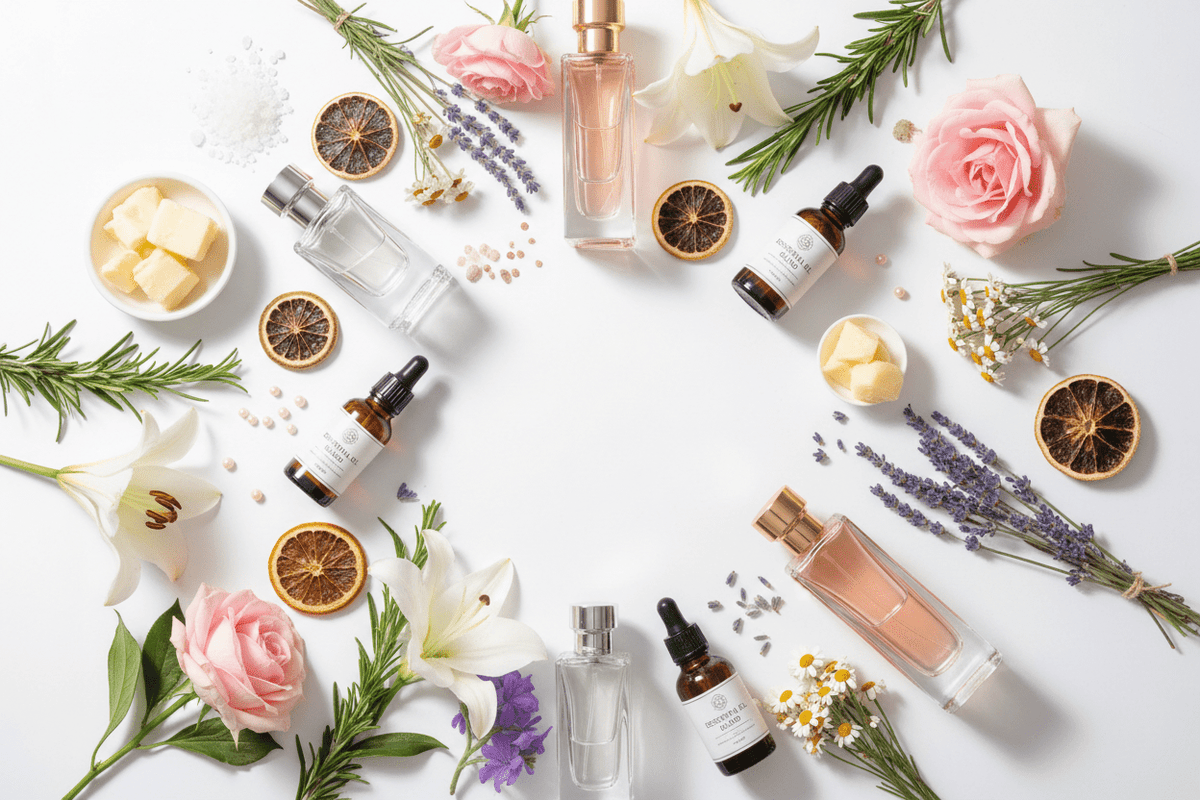
The Truth About Fragrance in Skincare
When I started developing Celulah Skin, there were certain things I knew I didn’t want in the formulas.
Added fragrance was one of them.
Not because every person who uses fragranced skincare will have a reaction. Plenty of people use it without a problem.
My reasoning was much simpler.
I was creating skincare with sensitive, reactive and easily irritated skin in mind. I wanted to be able to look at the ingredients in every formula and understand why they were there.
And when it came to fragrance, I kept coming back to the same question:
If it isn’t there to benefit the skin, why would I deliberately add it to skincare for sensitive skin?
The more you understand about fragrance — including fragrance allergy, skin reactions and the ability of certain fragrance substances to react with UV exposure — the more that decision makes sense.
Why Is Fragrance Added to Skincare?
Usually, because we like things that smell nice.
Fragrance can make a cream feel luxurious, disguise the natural odour of raw ingredients or create a sensory experience that becomes part of a brand’s identity.
On an ingredient list, you may see terms such as:
- Parfum
- Fragrance
- Aroma
A fragrance may itself be a mixture of multiple aromatic substances rather than one individual ingredient.
But here’s the distinction that matters to me:
Your skin doesn’t need your skincare to smell beautiful.
Fragrance isn’t necessary for a cleanser to cleanse.
It isn’t required for a moisturiser to moisturise.
And it isn’t needed for a serum to hydrate.
Its primary purpose in skincare is scent.
For Celulah, that wasn’t enough of a reason for me to include it.
Is Fragrance Actually Bad for Your Skin?
This is where skincare conversations often become too black and white.
Is every fragranced product bad?
No.
Will everyone react to fragrance?
No.
But can fragrance cause genuine skin problems in susceptible people?
Yes.
Fragrance is a recognised cause of allergic contact dermatitis, and fragrances are among the common causes of contact reactions to cosmetics. Importantly, fragrance allergy can develop after previous exposure — so having used fragranced products in the past without a reaction doesn’t mean sensitisation can never occur.
That’s particularly relevant to me when formulating products intended for people who already describe their skin as sensitive or reactive.
I don’t need to believe fragrance is universally harmful to decide that I’d rather leave it out.
Irritation and Fragrance Allergy Aren’t the Same Thing
These terms are often used interchangeably, but they’re different.
Irritant contact dermatitis occurs when something directly irritates the skin.
Allergic contact dermatitis involves an immune response after someone has become sensitised to an allergen.
Fragrance chemicals can cause allergic contact dermatitis in sensitised individuals. Symptoms can include redness, itching, swelling, burning or dermatitis, and reactions may occur hours or even days after exposure.
That’s why sometimes it isn’t obvious which product caused the problem.
And it also explains why someone
“But I’ve used fragrance for years and I’ve never had an issue.”
That may be completely true.
But allergy doesn’t necessarily have to appear the first time you’re exposed to something.

Can Fragrance and UV Exposure Contribute to Pigmentation?
This is one aspect of fragrance I think deserves far more attention.
Certain fragrance substances can cause a reaction when they’re present on the skin and subsequently exposed to ultraviolet light.
This is known as a photocontact reaction.
Photocontact dermatitis can occur when UV or visible light interacts with a photoreactive substance on the skin. Fragrances and perfumes are among the substances capable of causing these reactions.
A classic example involves bergamot oil and related photosensitising compounds.
Certain plant-derived substances contain compounds called psoralens, which can become phototoxic when exposed to UVA. Historically, bergamot-containing perfumes have been associated with this type of reaction.
And here’s the part particularly relevant to pigmentation:
Phototoxic reactions can be followed by significant pigmentation.
That doesn’t mean every fragrance causes pigmentation.
It doesn’t mean applying a fragranced moisturiser and walking outside will automatically give you dark spots.
The reaction depends on the particular substance, its concentration, UV exposure and the individual.
But some fragrance-related substances can participate in phototoxic or photoallergic reactions, and pigmentation can follow certain phototoxic reactions.
For someone already concerned about uneven pigmentation, that’s worth understanding.
And once again, it brings me back to the same question:
Why add fragrance to facial skincare when the skin doesn’t need it?
“Natural Fragrance” Doesn’t Automatically Mean Gentler
This is another skincare marketing message I’m wary of.
We tend to associate words such as:
Natural.
Botanical.
Plant-based.
with gentle skincare.
But where an ingredient comes from doesn’t automatically determine whether your skin will tolerate it.
Plants are made from chemicals too.
Natural aromatic substances can contain compounds capable of causing irritation, allergic reactions or photosensitivity.
Natural doesn’t automatically mean gentle.
And synthetic doesn’t automatically mean harmful.
I care much more about what an ingredient does within the formula than whether its name sounds natural.
What About Essential Oils?
Essential oils deserve the same consideration.
Lavender.
Peppermint.
Citrus.
Eucalyptus.
Rose.
Tea tree.
They sound beautiful — and for many people they’re an enjoyable part of personal care.
But essential oils contain naturally occurring aromatic compounds, and allergic contact dermatitis to essential oils is well recognised. Certain perfumes, fragrances and plant-derived substances can also be involved in photocontact reactions.
So when I was deciding whether Celulah needed essential oils, my question wasn’t:
“Are essential oils natural?”
It was:
“What am I trying to achieve by putting them into this formula?”
If the answer was primarily scent, I didn’t need them.
That’s why Celulah is formulated without added fragrance or essential oils.
What About Fragrance, Allergies, Hay Fever and Asthma?
Fragrance isn’t only something we experience through our skin.
We breathe volatile fragrance compounds too.
Some people are much more sensitive to strong scents than others.
Fragrance exposure can cause eye, nose and throat irritation and can trigger coughing, wheezing or shortness of breath in susceptible people. People with asthma and allergies may be particularly sensitive to fragranced products.
But there’s an important distinction here.
I wouldn’t tell you that fragrance causes asthma or hay fever.
That’s not the claim.
Rather, strong fragrances can trigger or exacerbate respiratory symptoms in some people who are susceptible.
And when you’re talking about skincare — something you’re applying directly around your face, nose and neck — I think that’s another reasonable consideration.
Especially when fragrance isn’t necessary for the skincare product to perform its primary function.
Why Can You Suddenly Start Reacting to Something You’ve Always Used?
This is something people often find difficult to understand.
They’ll tell me:
“It can’t be my skincare. I’ve used this product for years.”
But previous tolerance doesn’t completely rule out a future problem.
Allergic contact dermatitis requires sensitisation, and fragrance allergy may develop after repeated exposure. Cosmetic allergy can also occur after someone has used a product previously without difficulty.
That doesn’t mean fragrance is automatically responsible whenever someone’s skin suddenly becomes reactive.
There are many possibilities.
But if you’ve developed persistent redness, itching, burning or dermatitis, it’s reasonable to look at your entire routine — including fragrance.
Fragrance-Free Doesn’t Mean a Product Won’t Smell
This is another misconception.
A product formulated without added fragrance can still have a smell.
Cosmetic ingredients have their own natural odours.
Sometimes you’ll barely notice them.
Sometimes you’ll notice a slight raw-material scent when you first apply a product.
That’s normal.
Personally, I’d rather allow a formula to smell like its ingredients than add perfume purely to disguise them.
Celulah products aren’t designed to perfume your face.
They’re designed to care for your skin.
Is “Unscented” the Same as “Fragrance-Free”?
Not necessarily.
A product having no obvious smell doesn’t always mean no fragrance material has been used. Some products may contain masking fragrance ingredients specifically to neutralise the smell of other ingredients.
That’s why, if avoiding fragrance matters to you, I think it’s worth looking beyond the way a product smells.
Read the ingredient list.
Understand what you’re buying.
But Fragrance-Free Doesn’t Automatically Mean Better Skincare
This is important because I don’t want to replace one misleading marketing rule with another.
Putting FRAGRANCE FREE on a bottle doesn’t automatically make the formula brilliant.
A fragrance-free product can still contain ingredients your individual skin doesn’t tolerate.
It could still be too strong for you.
It could still be the wrong texture for your skin.
It could contain active ingredients you don’t need.
The entire formulation matters.
Fragrance-free is one decision within a formula.
It’s a decision I strongly believe in for Celulah, but it’s not the only thing that makes a skincare formula suitable for sensitive skin.
If Your Skin Is Burning, Don’t Automatically Blame Fragrance
Fragrance is one possible culprit.
It’s not the only one.
If products suddenly sting, consider what’s changed.
Did you start a retinoid?
Increase exfoliation?
Introduce a new serum?
Change cleansers?
Start several new products at once?
Is your skin already dry or irritated?
Understanding the timing can tell you much more than simply assuming you’re allergic to everything.
Read: Why Does My Skin Burn After Applying Skincare?
Do You Need to Throw Away Every Fragranced Product You Own?
No.
If you love a fragranced product, have used it comfortably and your skin is happy, I’m not going to tell you to throw your bathroom cupboard in the bin.
This isn’t about frightening people into believing fragrance is toxic.
It’s about explaining why I personally don’t believe it needs to be in Celulah skincare.
There’s a big difference.
You may tolerate fragrance beautifully.
Someone else’s skin may not.
But when I’m starting with a blank formula and deciding what belongs in skincare specifically created with sensitive and reactive skin in mind, my answer is clear:
I don’t need fragrance in it.
Why Celulah Skin Is Fragrance-Free
When I created Celulah, I didn’t only think about what I wanted to put into the formulas.
I thought very carefully about what I could leave out.
I wanted skincare for the person who turns the bottle around before buying it.
The person who reads every ingredient.
The person whose bathroom cupboard is full of products they bought hoping this one would finally suit their skin.
The person who is tired of being told something is “gentle” simply because the packaging says so.
That’s why Celulah formulas are made without added fragrance and essential oils.
Instead, depending on the product, you’ll find ingredients chosen for specific functional roles, including:
- Ceramides
- Panthenol
- Beta-glucan
- Ectoin
- Squalane
- Niacinamide
- Hyaluronic acid
- Peptides
I can explain why I chose those ingredients.
That’s important to me.
Read: What Does Panthenol (Vitamin B5) Do for Your Skin?
Read: Ceramides Explained — Why Your Skin Needs Them
Every Ingredient Should Have a Reason
When I say I want ingredients to have a reason for being in a formula, I don’t mean every ingredient needs to be an exciting active.
Good cosmetic formulations need preservatives, emulsifiers, stabilisers and other functional ingredients.
They might never appear in an Instagram headline, but they have important jobs.
Fragrance is different for me.
Its primary purpose in skincare is scent.
And when I’m formulating for sensitive skin, scent isn’t a good enough reason for me to add another potential source of irritation or sensitisation.
I’d rather leave it out.
The Bottom Line
So, is fragrance bad for everyone’s skin?
No.
Does everyone who uses fragranced skincare develop an allergy?
No.
But fragrance can cause allergic contact dermatitis in susceptible people. Certain fragrance substances can be involved in reactions with UV exposure, with some phototoxic reactions capable of leaving pigmentation. And strong fragrances can trigger respiratory symptoms in some people with asthma or other sensitivities.
And none of those potential issues come with an essential skincare benefit.
That’s what matters to me.
Celulah isn’t fragrance-free because fragrance-free skincare is fashionable.
It’s fragrance-free because I was creating products with sensitive and reactive skin in mind, and I couldn’t find a good enough reason to add fragrance simply to make them smell beautiful.
I’d rather use skincare because of what it does for my skin — not because of what it smells like.
Sometimes thoughtful formulation isn’t only about what you put in.
It’s about knowing what you don’t need to add.
Celulah Skin
Barrier-first skincare for sensitive, reactive and easily overwhelmed skin.
This article provides general skincare information and isn’t intended to diagnose or treat a medical condition. Persistent or significant skin or respiratory symptoms should be assessed by an appropriately qualified healthcare professional.



Leave a comment
This site is protected by hCaptcha and the hCaptcha Privacy Policy and Terms of Service apply.