
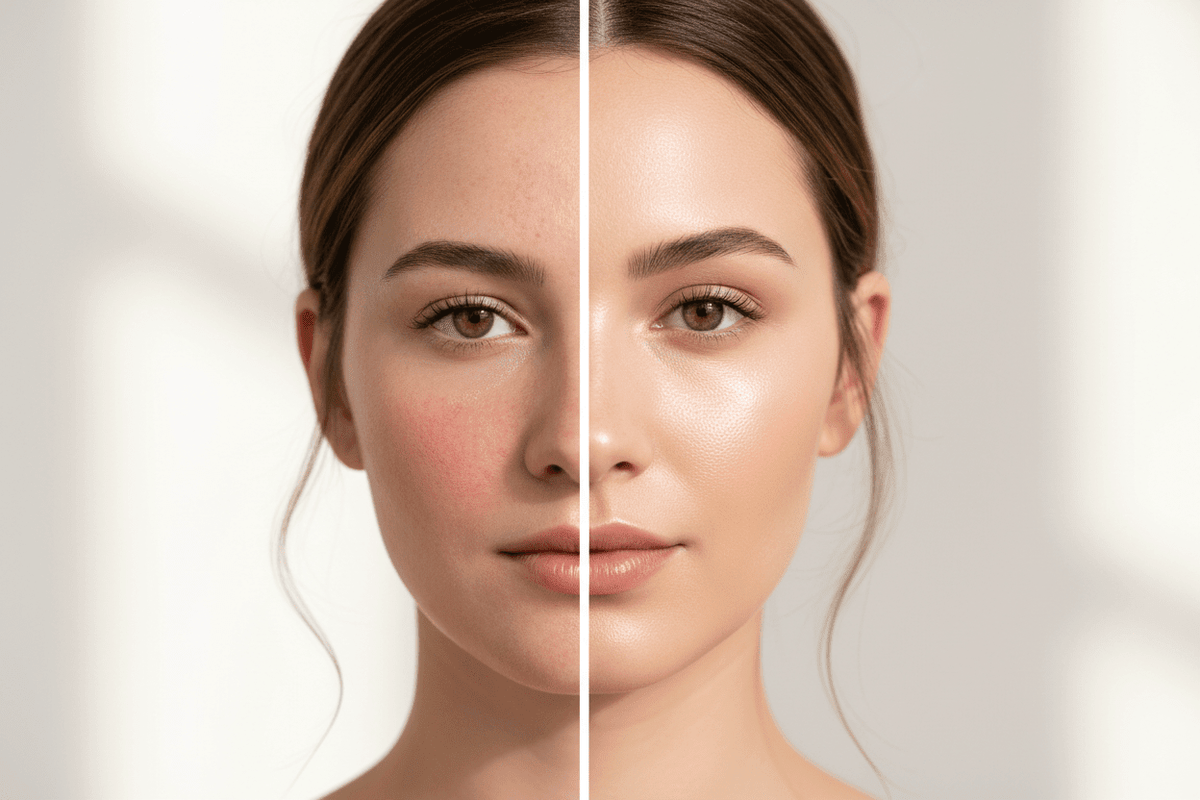
How to Repair a Damaged Skin Barrier
How to repair a damaged skin barrier often starts with recognising when your skin needs less, not more.
Your moisturiser suddenly feels uncomfortable. Your face feels tight after cleansing. Products you have used for months no longer feel the same, so you add something new hoping it will solve the problem.
And sometimes, your skin becomes even more reactive.
The answer may not be another active ingredient.
A damaged or compromised skin barrier may simply need fewer potential irritants, consistent hydration, moisturisation and time to recover.
When skin becomes dry, tight, flaky or unusually reactive, simplifying your routine can help create the conditions needed to support normal barrier function.
What is the skin barrier?
The skin barrier is the outermost part of the skin and forms an important protective boundary between the body and the external environment.
One of its major roles is helping keep water in while limiting exposure to potential irritants and environmental stressors.
A common way to visualise part of the outer skin barrier is the “bricks and mortar” analogy.
The skin cells are the bricks.
The lipids surrounding them — including ceramides, cholesterol and fatty acids — form part of the mortar.
Together, they create an effective protective barrier.
When barrier function is working well, it helps limit excessive water loss and supports the skin’s ability to protect itself from the environment.
When the barrier becomes compromised, water can escape more easily and skin may become more vulnerable to irritation.
This is when you may begin noticing dryness, tightness, flaking or products that previously felt comfortable suddenly feeling different.
What causes a damaged skin barrier?
There is not always one obvious cause.
Often, several factors are happening at the same time.
Possible contributors include:
- Over-cleansing or cleansing too frequently
- Cleansers that feel too stripping for your skin
- Overusing AHAs, BHAs or other exfoliating acids
- Frequent physical exfoliation
- Using retinoids more often than your skin tolerates
- Layering several potentially irritating active ingredients
- Introducing too many new products at once
- Using ingredients your individual skin does not tolerate
- UV exposure
- Cold weather, wind and low humidity
Sometimes there is no single “bad” product.
You may tolerate your cleanser.
You may tolerate your retinoid.
You may tolerate your exfoliating acid.
But increasing the frequency of all three at the same time can affect the skin differently from using each product individually.
The whole routine matters.
Can too much skincare damage your skin barrier?
Too much skincare can contribute to barrier disruption, particularly when “more skincare” means more exfoliation, more potentially irritating actives or more frequent cleansing.
When skin is not behaving the way we want, it can be tempting to add another product.
Texture? Add an acid.
Fine lines? Add a retinoid.
Pigmentation? Add another active.
Breakouts? Exfoliate more.
Dryness? Add another serum.
Many of these ingredients can be useful when used appropriately.
The problem comes when skin is expected to address every concern simultaneously.
If your routine has gradually become more complicated while your skin has become increasingly reactive, it may be worth considering whether your skin needs fewer products for a while.
What are the signs of a damaged skin barrier?
A damaged or compromised skin barrier can look and feel different from person to person.
Possible signs can include:
- Tightness, particularly after cleansing
- Dryness or flaky patches
- Increased sensitivity
- Skin feeling uncomfortable when skincare is applied
- Rough or uneven-feeling skin
- Dehydration
- Skin feeling oily and dehydrated at the same time
- Breakouts occurring alongside dryness and irritation
- Makeup clinging to dry areas or emphasising texture
- Products you previously tolerated suddenly feeling uncomfortable
One of these symptoms alone does not necessarily mean the skin barrier is damaged.
Dryness, itching, flaking, discomfort and breakouts can have many possible causes.
However, if several changes appear together — particularly after increasing exfoliation, introducing new actives or significantly changing your routine — it may be worth reassessing your skincare.
Persistent, severe or unexplained symptoms should be assessed by an appropriately qualified healthcare professional.
Why can skincare suddenly feel uncomfortable when the barrier is compromised?
This can be particularly confusing when a product has been used comfortably for months.
The product may not have changed.
Your skin may have.
When the outer barrier is compromised, the skin can become more susceptible to irritation. Products that previously felt completely comfortable may suddenly feel different.
That does not automatically mean you have developed an allergy to the product.
However, it can be a useful sign that your routine needs reassessing rather than continually adding new products.
How to repair a damaged skin barrier
When skin feels dry, sensitive and overwhelmed, the answer is not automatically another treatment.
For a while, your skincare routine may need to become much simpler.
The aim is to reduce unnecessary sources of irritation while supporting hydration, moisturisation and normal skin barrier function.
1. Start with your cleanser
Cleansing is an important place to start when supporting a damaged skin barrier.
A cleanser should remove sunscreen, makeup, excess oil and daily impurities without leaving the skin feeling excessively tight or stripped.
After cleansing, consider how your skin feels.
Does it feel clean and comfortable?
Or does it immediately feel tight and as though moisturiser is urgently needed?
If it is consistently the second, your cleanser or cleansing routine may be too much for your skin at the moment.
For particularly dry or easily stripped skin, a creamy, non-stripping cleanser may feel more comfortable.
2. Consider pausing exfoliation
If skin feels flaky, unusually sensitive or uncomfortable, this may not be the right time for another exfoliation night.
AHAs and BHAs can be useful skincare ingredients.
That does not mean they need to be used every day or during periods when the skin is already struggling.
Consider temporarily reducing or pausing exfoliating acids and physical scrubs while your skin settles.
They can always be reassessed later.
Your routine does not need to address every skin concern while your barrier is recovering.
3. Reassess retinoids and strong actives
Retinoids can be valuable age-supporting skincare ingredients, but frequency and individual tolerance matter.
If skin is persistently uncomfortable, continuing to increase the strength or frequency is not necessarily helpful.
Consider whether particular products may currently be contributing to irritation.
Once the skin feels comfortable and stable again, active ingredients can be reintroduced gradually according to individual tolerance.
Stronger skincare is not automatically better skincare.
4. Restore hydration
A compromised barrier can increase water loss from the skin, making hydration particularly important.
Humectants are ingredients that help attract and retain water.
Examples include:
- Glycerin
- Panthenol
- Hyaluronic acid
- Beta-glucan
However, attracting water is only part of the picture.
The skin also needs to retain that moisture.
This is where moisturisers, emollients and barrier-supporting lipids can be particularly useful.
5. Moisturise consistently
Rather than continually changing moisturisers in search of instant relief, find a formula your skin tolerates and use it consistently.
A well-balanced moisturiser can support the skin in several ways.
Look for combinations of:
Humectants to support hydration.
Emollients to soften and smooth the skin.
Barrier-supporting lipids to complement the structure of the outer skin barrier.
The heaviest cream is not automatically the best moisturiser for a damaged skin barrier.
The right texture depends on your individual skin and should be comfortable enough to use consistently.
6. Protect skin from UV exposure
Sun protection remains important while supporting the skin barrier.
UV exposure can affect skin barrier function while also contributing to premature visible ageing and pigmentation.
Use an appropriate broad-spectrum sunscreen during the day according to its directions.
If your usual sunscreen suddenly feels uncomfortable while your skin is reactive, look for a formulation that your skin tolerates more comfortably rather than abandoning sun protection altogether.

Best ingredients for a damaged skin barrier
There is no single ingredient that can repair every damaged skin barrier.
The complete formulation matters more than one fashionable hero ingredient.
However, several ingredients are commonly used in barrier-focused skincare because of the roles they can play in hydration, moisturisation and skin comfort.
Ceramides and cholesterol
Ceramides are lipids naturally found within the skin barrier.
But they do not exist there alone.
The skin barrier contains a mixture of lipids including ceramides, cholesterol and fatty acids.
Together, these lipids play an important role in the structure of the outer skin barrier and its ability to limit excessive water loss.
This is why the complete formulation matters rather than simply choosing a product because the packaging says “contains ceramides”.
Celulah Skin Peptide Barrier Cream contains Ceramides 1, 3 and 6 together with cholesterol as part of its barrier-focused formula.
Read: Ceramides Explained - Why Your Skin Needs Them
Panthenol - Vitamin B5
Panthenol is a humectant that helps attract and retain moisture while supporting skin hydration and comfort.
It can be particularly useful in barrier-focused skincare because it does not rely on exfoliating or aggressively stimulating the skin to perform its role.
Read: What Does Panthenol (Vitamin B5) Do for Your Skin?
Beta-glucan
Beta-glucan is commonly used in skincare to support hydration and skin comfort.
It can be particularly useful in formulations created for dry or sensitive-feeling skin.
Squalane
Squalane is an emollient that helps soften and smooth the skin while reducing moisture loss.
It can provide nourishing emollience without necessarily requiring an extremely heavy formulation.
Hyaluronic acid
Hyaluronic acid is a humectant that helps attract and retain water.
This makes it useful for supporting hydration, particularly when skin feels dehydrated.
However, hyaluronic acid alone is not a complete skin barrier routine.
The surrounding formulation still matters.
Ectoin
Ectoin is used in skincare to support hydration, skin comfort and resilience against environmental stressors.
It can complement formulations designed for sensitive, dry and barrier-compromised skin.
How long does a damaged skin barrier take to recover?
There is no universal recovery time for a damaged skin barrier.
Skin does not operate on an exact countdown timer.
Recovery can depend on:
- How compromised the barrier is
- What contributed to the problem
- Whether the trigger is still present
- The skincare routine being used
- Environmental factors
- Individual skin characteristics
Some people may notice that tightness or discomfort improves relatively quickly after removing something that was aggravating the skin.
More significant barrier disruption may take longer.
Instead of expecting the skin barrier to be “fixed” within a particular number of days, look for gradual changes such as:
- Less tightness after cleansing
- Basic skincare feeling more comfortable
- Improved hydration
- Less flaking
- The skin feeling more stable overall
Barrier recovery is not a race.
Consistency matters more than trying to force the skin to change quickly.
What should you avoid while your skin barrier is recovering?
A recovery period is generally not the ideal time to experiment with several new products.
Depending on your skin and what is contributing to the problem, it may be worth temporarily reducing or avoiding:
- Exfoliating acids
- Physical scrubs
- Retinoids if they are currently causing significant irritation
- Strong or stripping cleansers
- Products already known to trigger your skin
- Introducing several new active ingredients simultaneously
That does not mean these products need to be avoided forever.
The aim is to stop continually challenging skin that is already struggling.
Once the skin feels comfortable and stable again, other products can be reintroduced gradually if desired.
What about fragrance?
Added fragrance is another factor worth considering when the skin is particularly reactive.
Many people tolerate fragranced skincare without difficulty.
However, fragrance can cause irritation or allergic contact dermatitis in susceptible individuals and is not necessary for a cleanser, serum or moisturiser to perform its basic skincare function.
Celulah Skin products are formulated without added fragrance or essential oils as part of the brand’s approach to skincare for sensitive, reactive and barrier-compromised skin.
Read: The Truth About Fragrance in Skincare
Can a damaged skin barrier cause breakouts?
Breakouts and barrier disruption can occur at the same time.
This can sometimes create a frustrating cycle.
Skin breaks out, so exfoliation is increased.
Another treatment is introduced.
The skin becomes drier and more uncomfortable.
Another product is added.
Soon, breakouts are occurring alongside tightness, flaking or sensitivity.
If this sounds familiar, stronger skincare is not automatically the answer.
Consider the entire routine rather than treating each symptom separately.
Persistent, severe or painful acne should be discussed with an appropriately qualified healthcare professional.
What does a skin barrier repair routine look like?
Learning how to repair a damaged skin barrier does not require an elaborate routine.
During recovery, a simple routine may look like this:
Morning
Gentle cleanse if needed → Moisturiser → Broad-spectrum sunscreen
If skin is particularly dry, cleansing again in the morning may not always be necessary.
Evening
Gentle cleanser → Hydrating or barrier-supporting serum if tolerated → Moisturiser
That may be enough for a while.
Additional products can always be introduced later.
Consistency is often more useful than trying to maintain a complicated routine while the skin is reactive.
A simple routine for dry, sensitive and barrier-compromised skin

When skin feels dry, tight, sensitive or overwhelmed, start with the fundamentals:
Cleanse without stripping.
Restore hydration.
Support the skin barrier.
Protect the skin during the day.
This same approach forms the basis of the Celulah Skin Barrier Repair Routine.
The three products have different roles within a simple barrier-focused routine.
Step 1: Soft Skin Cleanser
Celulah Skin Soft Skin Cleanser is designed for dry, sensitive and reactive skin.
The creamy, non-stripping formula combines gentle cleansing agents with ingredients including squalane, beta-glucan, allantoin and ceramides.
It is designed to cleanse without chasing the tight, squeaky-clean feeling that dry and sensitive skin often does not tolerate well.
Step 2: Pink Calm Serum
Pink Calm Serum adds lightweight hydration and barrier-supporting ingredients.
The formula includes Vitamin B12, niacinamide, panthenol, ectoin, beta-glucan, allantoin, hyaluronic acid, squalane and ceramides.
It is designed for sensitive and reactive skin that needs hydration and support without introducing an aggressive treatment step.
Its recognisable pink colour comes from Vitamin B12 rather than added fragrance or botanical colourants.
Step 3: Peptide Barrier Cream
Peptide Barrier Cream completes the routine with moisturisation and barrier support.
The formula combines ceramides and cholesterol with panthenol, ectoin, niacinamide, squalane, hyaluronic acid and peptides.
It is designed to provide hydration and barrier support without assuming that sensitive or dry skin always needs an extremely heavy or greasy moisturiser.
Together, these products form the Celulah Skin Barrier Repair Routine for skin that feels dry, sensitive, reactive or barrier-compromised.
Celulah Skin products are formulated without added fragrance or essential oils.
Shop the Barrier Repair Routine
Frequently Asked Questions
Can a damaged skin barrier repair itself?
The skin barrier naturally renews and maintains itself. Removing ongoing sources of irritation and supporting hydration and moisturisation can help create better conditions for normal barrier recovery.
What is the fastest way to repair a damaged skin barrier?
There is no guaranteed overnight solution. A simplified routine, gentle cleansing, consistent moisturisation, reduced exposure to irritating products and daily sun protection can help support recovery.
Should you stop all skincare when your barrier is damaged?
Not necessarily. A simple routine based around gentle cleansing, moisturisation and sun protection may be more appropriate than stopping skincare completely.
Can you use niacinamide with a damaged skin barrier?
Niacinamide is commonly used in barrier-supporting skincare, but individual tolerance varies. If skin is currently very reactive, the complete formulation and concentration are important.
Are ceramides good for a damaged skin barrier?
Ceramides are naturally present in the skin barrier and are commonly included in moisturisers designed to support dry and barrier-compromised skin.
How do you know when your skin barrier is getting better?
Possible signs include less tightness after cleansing, less flaking, improved hydration and basic skincare products feeling comfortable again.
The bottom line
If your skin barrier feels compromised, resist the urge to fix everything at once.
You may not need another exfoliant.
Another strong active.
Another viral serum.
Or another ten-step routine.
Start with what your skin needs now.
Reduce what appears to be aggravating it.
Cleanse gently.
Restore hydration.
Moisturise consistently.
Protect the skin from UV exposure.
Then give it time.
Understanding how to repair a damaged skin barrier is less about forcing the skin to change faster and more about creating supportive conditions for normal barrier function and recovery.
Once skin feels comfortable and stable again, other skincare can be reconsidered according to individual needs and tolerance.
Celulah Skin
Barrier-first skincare for sensitive, reactive and barrier-compromised skin.
This article provides general skincare information and is not intended to diagnose or treat a medical condition. Persistent, severe or unexplained skin symptoms should be assessed by an appropriately qualified healthcare professional.


Leave a comment
This site is protected by hCaptcha and the hCaptcha Privacy Policy and Terms of Service apply.