
What Is the Skin Barrier and Why Does It Matter?
If you’ve spent any time researching skincare, you’ve probably heard the term “skin barrier.”
But what actually is your skin barrier — and why does everyone suddenly seem to be talking about it?
As a Dermal Therapist and Nurse, I think understanding your skin barrier is one of the most useful things you can learn about your skin.
Once you understand what it does, things like dryness, dehydration, sensitivity and even why certain products suddenly sting can start to make much more sense.
What is the skin barrier?
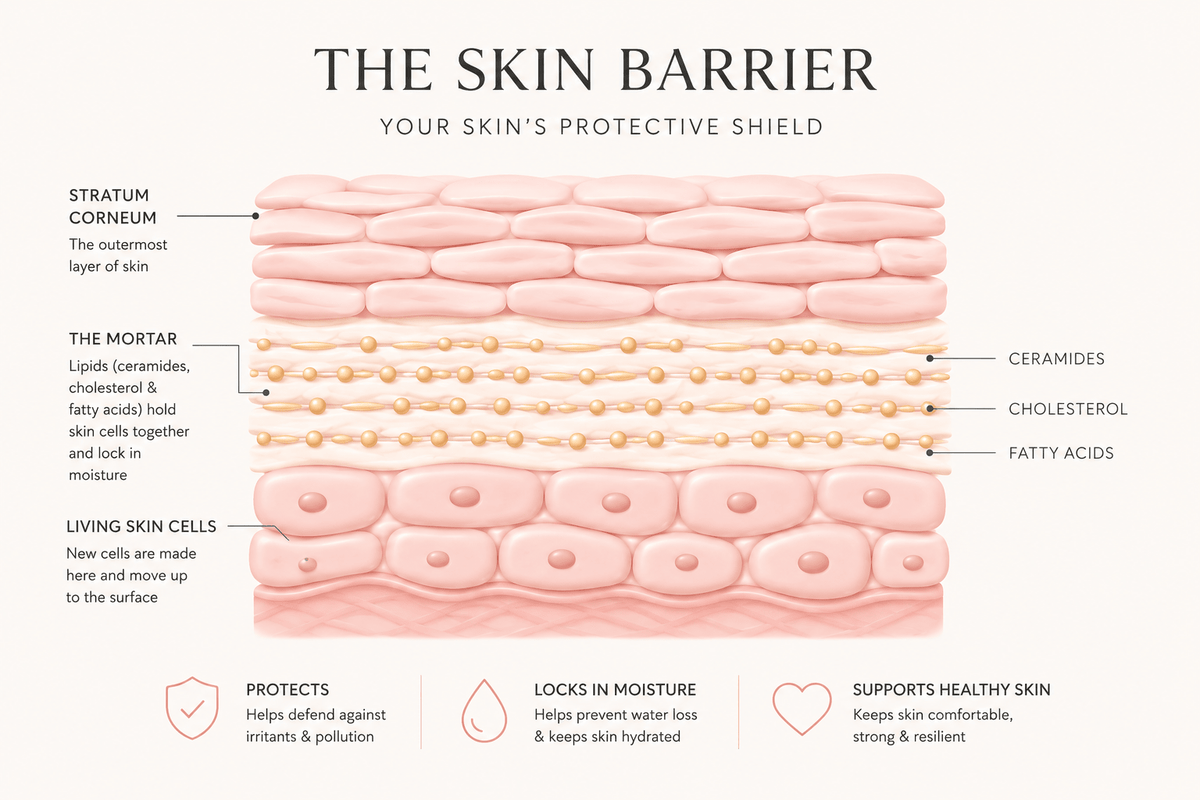
The skin barrier refers primarily to the outermost part of your epidermis, known as the stratum corneum.
A simple way to picture it is like a brick wall.
The skin cells are the bricks, while lipids — including ceramides, cholesterol and fatty acids — help form the mortar around them.
Together, this structure creates an important protective barrier between your body and the outside environment.
What does your skin barrier actually do?
One of the skin barrier’s most important jobs is helping to limit water loss from the skin.
It also forms part of your skin’s defence against the external environment.
When barrier function is working effectively, skin is generally better able to retain moisture and remain comfortable.
When it’s disrupted, you may experience increased dryness, tightness or sensitivity.
So although we often talk about the skin barrier as though it’s another skincare trend, it’s actually a fundamental part of normal skin function.
What can damage or disrupt the skin barrier?
There isn’t one single cause.
Barrier function can be affected by a combination of your skincare routine, environment and individual skin.
Things that may contribute include:
- Over-cleansing
- Frequent or aggressive exfoliation
- Using several strong active products at once
- Retinoid irritation
- Very hot water
- Excessive sun exposure
- Cold or dry environments
- Using products your individual skin doesn’t tolerate
Even ingredients that can be beneficial for skin may become irritating when they’re used too frequently or when your skin is already struggling.
That’s why more skincare isn’t automatically better skincare.
Does foaming cleanser damage your skin barrier?
Not automatically.
This is an important misconception.
A cleanser doesn’t become harsh simply because it foams.
The type and concentration of surfactants, overall formulation, how frequently you cleanse and your individual skin all matter.
A well-formulated foaming cleanser can be suitable for sensitive skin, while a cleanser marketed as “gentle” may still not suit your particular skin.
One of the simplest things to pay attention to is how your skin feels afterwards.
If it regularly feels stripped, dry or uncomfortably tight, your cleansing routine may need adjusting.
Read: Why Does My Skin Feel Tight After Cleansing?

What are the signs of a compromised skin barrier?
There isn’t one symptom that definitively tells you your skin barrier is damaged.
However, you might notice a combination of:
- Increased dryness
- Flaking
- Tightness
- Rough texture
- Increased sensitivity
- Burning or stinging when applying products
- Redness
- Products you’ve previously tolerated suddenly feeling uncomfortable
The biggest clue can sometimes be change.
If your skin was previously comfortable and suddenly seems to react to everything, it’s worth looking at what has changed in your routine.
Read: Damaged Skin Barrier Signs: How to Tell If Your Skin Barrier Is Compromised
Is sensitive skin the same as a damaged skin barrier?
No.
You can naturally have sensitive skin without having a damaged skin barrier.
Likewise, someone who doesn’t normally consider their skin sensitive may temporarily experience increased sensitivity when their barrier is compromised.
The two can overlap, but they’re not the same thing.
This distinction matters because not every person with sensitive skin needs to be told their barrier is “damaged.”
Why are ceramides important for the skin barrier?
Ceramides are lipids naturally found within the outer layers of your skin and form an important part of its barrier structure.
Alongside cholesterol and fatty acids, they help maintain the lipid environment surrounding the cells of the stratum corneum.
This is why ceramides are commonly found in skincare formulated for dry, sensitive or barrier-focused routines.
Read: Ceramides Explained — Why Your Skin Needs Them
What skincare ingredients can support the skin barrier?
Rather than looking for one miracle “barrier repair” ingredient, I prefer formulations that combine ingredients performing complementary roles.
Depending on the product, these might include:
Ceramides
Barrier lipids that form part of the skin’s natural structure.
Panthenol
Also known as Vitamin B5, panthenol is a humectant that supports hydration and skin comfort.
Squalane
An emollient that helps soften the skin and reduce moisture loss.
Glycerin and hyaluronic acid
Humectants that help attract and retain water.
Niacinamide
Niacinamide can support skin barrier function, although individual tolerance and the complete formulation matter.
Ectoin
Ectoin is used in skincare to support hydration and help protect against environmental stressors.
How do you support a damaged skin barrier?
If your skin is currently irritated, this usually isn’t the time I’d introduce five new active ingredients.
Start by looking at the foundation of your routine.
You may benefit from:
1. Gentle cleansing
Use a cleanser that removes what you need it to remove without leaving your skin feeling stripped.
2. Moisturising consistently
Choose a moisturiser that provides enough hydration and comfort for your individual skin.
3. Reducing irritating products
If a particular product is consistently causing burning or discomfort, stop forcing your skin to tolerate it.
4. Being cautious with exfoliation
If your skin is already irritated, increasing acids or scrubs may make it feel worse.
5. Daily sun protection
Use an appropriate broad-spectrum sunscreen according to its directions.
For a more detailed guide, read How to Repair a Damaged Skin Barrier.
How long does skin barrier repair take?
There’s no universal “four-to-six-week” rule.
How quickly skin feels better depends on what caused the problem, how significant the irritation is, your individual skin and what you’re doing to it.
Some mild irritation may settle relatively quickly once the trigger is removed. Other problems can take considerably longer.
If symptoms are persistent, severe or worsening, don’t assume you simply need to wait for your “barrier to repair.” There may be something else going on that requires appropriate assessment.
The Celulah approach to the skin barrier
The skin barrier is central to the way I formulate and think about skincare at Celulah.
I don’t believe sensitive skin needs to be constantly challenged to achieve results.
Instead, our formulas focus on ingredients selected to support hydration, skin comfort and barrier function, without added fragrance or essential oils.
That doesn’t mean every person needs exactly the same routine.
Dry sensitive skin may need something different from oily or combination sensitive skin.
And it doesn’t mean active ingredients are inherently bad.
It simply means I believe the foundation of your skin should be considered before constantly asking it to do more.
The bottom line
Your skin barrier isn’t a skincare trend.
It’s an important part of how your skin retains moisture and interacts with the world around it.
And supporting it doesn’t require an enormous routine.
Cleanse without unnecessarily stripping your skin.
Provide enough hydration and moisturisation for your skin type.
Protect your skin from the sun.
And pay attention when your skin tells you something isn’t working.
Understanding your skin barrier doesn’t mean you need to become afraid of skincare.
It means you can make better choices about what your skin actually needs.
Celulah Skin
Barrier-first skincare for sensitive, reactive and easily overwhelmed skin.
This article provides general skincare information and is not intended to diagnose or treat a medical condition. Persistent, severe or unexplained skin symptoms should be assessed by an appropriate healthcare professional.


Leave a comment
This site is protected by hCaptcha and the hCaptcha Privacy Policy and Terms of Service apply.