
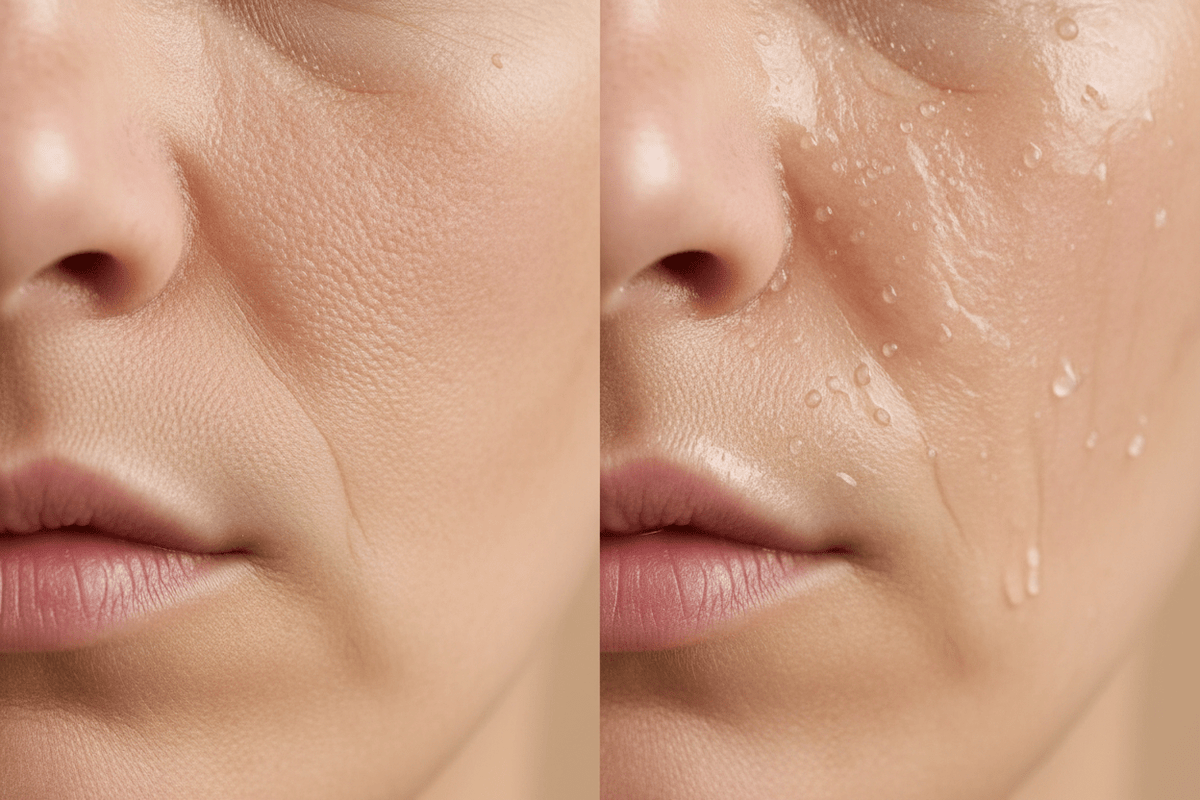
Dry Skin vs Dehydrated Skin: What’s the Difference?
Have you ever been told you have dry skin, but no matter how much moisturiser you apply, your skin still feels tight?
Or perhaps your skin looks oily but somehow still feels dehydrated and uncomfortable.
It can be confusing because dry skin and dehydrated skin can of look and feel very similar — but they’re not the same thing.
Dry skin is generally considered a skin type associated with lower oil production, while dehydrated skin describes a lack of water within the skin.
And yes — you can have oily, combination or dry skin and still experience dehydration.
Understanding the difference can help you choose skincare based on what your skin actually needs rather than continually adding richer creams or stronger products.
What Is Dry Skin?
Dry skin is generally a skin type that produces less sebum, or natural oil, than other skin types.
Sebum forms part of the lipid-rich environment at the skin’s surface and helps keep skin soft and reduce moisture loss.
If you naturally have dry skin, you may notice:
- Flaking or rough patches
- Persistent tightness
- A dull or less supple appearance
- Fine lines appearing more noticeable
- Skin feeling uncomfortable in cold or dry weather
- A preference for creamier cleansers
- Skin feeling better with richer moisturisers
Dry skin often needs both hydration and emollient or lipid-supporting ingredients to help maintain softness and comfort.
What Is Dehydrated Skin?
Dehydrated skin describes skin that doesn’t have enough water.
Unlike dry skin, dehydration isn’t limited to one skin type.
You can have:
Dry + dehydrated skin
Normal + dehydrated skin
Combination + dehydrated skin
or even:
Oily + dehydrated skin.
Signs of dehydrated skin can include:
- Tightness
- Dull or tired-looking skin
- Fine dehydration lines becoming more noticeable
- Skin feeling less plump
- Makeup sitting unevenly or catching on texture
- Skin feeling uncomfortable after cleansing
- Oiliness alongside feelings of tightness or dehydration
Dehydration can be influenced by several factors, including your environment, skincare routine and the condition of your skin barrier.
Can You Have Oily and Dehydrated Skin at the Same Time?
Absolutely.
This is one of the most common sources of confusion.
Oil and water are not the same thing.
Having plenty of oil on the surface of your skin doesn’t necessarily mean your skin is adequately hydrated.
Someone can naturally produce more sebum and still experience insufficient water within the skin.
This is why oily skin that feels tight after cleansing shouldn’t automatically be treated with harsher cleansers or more exfoliation.
If your skin is shiny but simultaneously feels tight, uncomfortable or dehydrated, it may be worth looking at both your cleansing routine and hydration.
Why Does Skin Become Dehydrated?
There isn’t one single cause.
Dehydration can be influenced by factors such as:
- Over-cleansing
- Cleansers that are too stripping for your skin
- Frequent exfoliation
- Overuse of strong active ingredients
- Low-humidity environments
- Cold or windy weather
- Air conditioning and heating
- Changes in your skin barrier
- A skincare routine that doesn’t provide enough hydration for your individual skin
Your skin barrier also plays an important role.
The outermost layer of your skin helps reduce excessive water loss.
When barrier function is compromised, transepidermal water loss (TEWL) can increase, meaning more water escapes through the skin.
The result can be skin that feels increasingly tight, dry or uncomfortable.
Read: Why Your Skin Barrier Matters

What’s the Difference Between Dry and Dehydrated Skin?
The easiest way to think about it is:
Dry skin = lacking oil
Dehydrated skin = lacking water
But real skin isn’t always that neat.
You can experience both simultaneously.
For example, someone with naturally dry skin may also become dehydrated after over-exfoliating or during winter.
That skin may need water-binding humectants plus emollient and barrier-supporting ingredients rather than simply one or the other.
How Can I Tell if My Skin Is Dry or Dehydrated?
There isn’t a perfect at-home test that can definitively diagnose dehydration.
Instead, look at the overall pattern.
Your skin may be predominantly dry if:
- It has generally been dry for a long time
- You naturally produce relatively little oil
- Roughness or flaking is common
- Richer moisturisers make your skin feel significantly more comfortable
- Dryness tends to occur across much of your face
Dehydration may be contributing if:
- Your skin suddenly feels tighter than usual
- Fine lines look temporarily more noticeable
- Your skin looks dull or less plump
- Your skin feels tight despite being oily
- Your skin feels particularly uncomfortable after cleansing
- Your skin has changed following increased exfoliation or active skincare
And remember:
You can have both.
Is the “Pinch Test” Accurate for Dehydrated Skin?
You’ve probably seen social media videos telling you to pinch the skin on your cheek or hand to determine whether your face is dehydrated.
I wouldn’t rely on this to diagnose dehydrated facial skin.
Skin elasticity and how quickly skin returns after being pinched can be affected by several factors, including age and the area of the body being tested.
Rather than relying on a viral test, pay attention to your skin’s overall behaviour and how it responds to your routine.
Why Does My Skin Feel Tight After Cleansing?
If tightness is particularly noticeable immediately after washing your face, look at your cleansing routine.
Your cleanser should remove sunscreen, makeup, excess oil and impurities without leaving your face feeling stripped.
Things worth considering include:
- The cleanser you’re using
- How frequently you’re cleansing
- Whether you’re double cleansing unnecessarily
- How much cleanser you’re using
- Whether you’re using very hot water
- Whether your skin is already irritated
Your face doesn’t need to feel squeaky clean to actually be clean.
Read: Why Your Skin Feels Tight After Cleansing
How to Care for Dehydrated Skin
If dehydration is the main concern, focus on adding hydration and helping your skin retain it.
1. Cleanse gently
Avoid repeatedly stripping the skin in an attempt to make it feel exceptionally clean.
2. Use humectants
Humectants attract and hold water.
Useful ingredients include:
- Glycerin
- Hyaluronic acid
- Panthenol
- Beta-glucan
3. Support your skin barrier
Ingredients such as ceramides can help support the lipid structure of the skin barrier.
Read: Ceramides Explained — Why Your Skin Needs Them
4. Follow with moisturiser
A hydrating serum alone may not provide everything your skin needs.
A moisturiser can provide emollience and help reduce moisture loss.
5. Be cautious with over-exfoliation
If your skin is already tight, stinging or uncomfortable, continually exfoliating it is unlikely to improve dehydration.
Give your skin time to recover.
How to Care for Dry Skin
Naturally dry skin generally needs more than water-binding ingredients alone.
Look for a combination of humectants, emollients and barrier-supporting ingredients.
These may include:
Ceramides — support the lipid structure of the skin barrier.
Squalane — an emollient that softens the skin and helps reduce moisture loss.
Glycerin — attracts water and supports hydration.
Panthenol — supports hydration and skin comfort.
Hyaluronic acid — attracts and retains water.
Beta-glucan — supports hydration and can help skin feel more comfortable.
The overall formulation matters more than finding a product containing every ingredient on this list.
Does Dehydrated Skin Need a Serum or Moisturiser?
It may benefit from both, but you don’t necessarily need a complicated routine.
Think about their roles differently.
A hydrating serum can deliver humectant ingredients that help attract and retain water.
A moisturiser can then provide additional hydration, emollience and ingredients that help reduce moisture loss.
For some people, moisturiser alone is enough.
Others prefer layering a lightweight hydrating serum underneath.
There isn’t one combination that’s right for everyone.
Can a Damaged Skin Barrier Cause Dehydrated Skin?
A compromised skin barrier can certainly contribute to increased water loss.
When the barrier isn’t functioning effectively, transepidermal water loss can increase and the skin may become more prone to dryness, tightness and sensitivity.
You may also notice:
- Products suddenly stinging
- Increased redness
- Flaking
- Roughness
- Skin becoming more reactive
- Moisturiser not seeming to provide lasting comfort
But dehydration doesn’t automatically mean your skin barrier is damaged.
Environment, skincare habits and other factors can also affect skin hydration.
Read: How to Repair a Damaged Skin Barrier
Can Menopause Make Skin Drier or Dehydrated?
Yes, hormonal changes during perimenopause and menopause can affect the skin.
Declining oestrogen is associated with changes in skin hydration, sebum production, collagen and skin thickness.
Someone who previously had normal or combination skin may suddenly find their skin feels much drier or requires different skincare than it did several years earlier.
Read: Why Has My Skin Changed During Menopause?
What About Fine Lines From Dehydration?
When skin is dehydrated, superficial lines can sometimes appear more noticeable because the skin looks less plump.
Improving hydration can make these dehydration lines appear softer and less noticeable.
That’s different from claiming hydration removes established wrinkles.
Fine lines associated with skin ageing are influenced by many factors, including collagen changes, facial movement, genetics and UV exposure.
Hydration can improve the appearance of the skin — but it doesn’t reverse the ageing process.
My Approach to Dry and Dehydrated Skin
As a Dermal Therapist and Nurse, I think one of the biggest mistakes we make with skin is treating every feeling of dryness in exactly the same way.
Someone with naturally dry skin may need more emollience.
Someone with oily but dehydrated skin may need hydration without an excessively heavy moisturiser.
And someone whose skin has suddenly become tight, flaky and reactive may need to look at whether their routine is disrupting their skin barrier.
That’s why I prefer looking at what the skin actually needs rather than simply attaching a label to it.
At Celulah Skin, our formulas focus on hydration, skin comfort and barrier-supporting ingredients including ceramides, panthenol, beta-glucan, ectoin, squalane and hyaluronic acid.
Because dry and dehydrated skin aren’t identical — and skincare shouldn’t treat them as though they are.
The Bottom Line
Dry skin and dehydrated skin are not the same thing.
Dry skin generally produces less natural oil.
Dehydrated skin lacks water.
And you can experience both at the same time.
If your skin feels tight, dull or uncomfortable despite looking oily, don’t automatically reach for a harsher cleanser.
If your naturally dry skin still feels uncomfortable after using a lightweight hydrating serum, it may need additional emollient and barrier support.
Understanding the difference gives you a much better starting point for choosing skincare that actually suits your skin.
Celulah Skin
Barrier-first skincare for sensitive, reactive and easily overwhelmed
This article provides general skincare information and isn’t intended to diagnose or treat a medical condition. Persistent or significant skin symptoms should be assessed by an appropriately qualified healthcare professional.


Leave a comment
This site is protected by hCaptcha and the hCaptcha Privacy Policy and Terms of Service apply.