
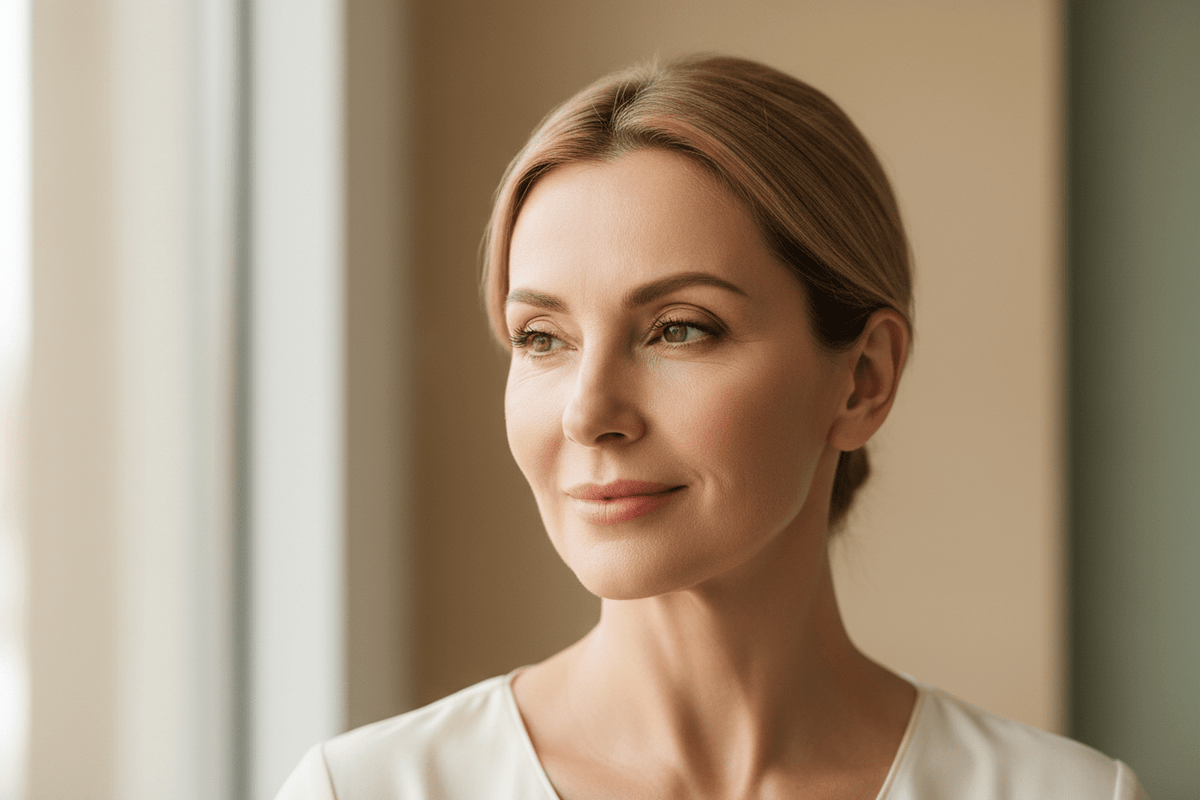
Menopause and Skin Changes: What’s Really Happening and How to Help
If your skin has changed during perimenopause or menopause, you’re not imagining it.
Skin may suddenly feel drier, thinner or more sensitive. Fine lines can become more noticeable, makeup may sit differently, and products you’ve used for years may no longer feel as comfortable.
Hormonal changes during perimenopause and menopause can affect collagen, hydration, oil production and the way the skin barrier functions.
Understanding what’s happening can make it much easier to choose skincare that supports your skin through these changes.
How does menopause affect your skin?
Oestrogen plays an important role in several processes within the skin, including collagen production, hydration and skin thickness.
As oestrogen levels decline during perimenopause and menopause, the skin may gradually produce less collagen and natural oil.
You may notice:
- Increased dryness
- More noticeable fine lines
- Reduced firmness
- Changes in skin texture
- Increased sensitivity
- Skin feeling thinner or more fragile
- Products suddenly feeling uncomfortable
These changes can happen gradually, but for many women they seem to become noticeable quite suddenly.
Read: Why Does My Skin Suddenly Feel Older? A Nurse Explains
Why does menopausal skin become drier?
One of the most common changes during menopause is dryness.
As natural oil production decreases and the skin’s ability to retain moisture changes, water can escape more easily from the surface of the skin.
This can leave skin feeling:
- Tight
- Rough
- Flaky
- Dehydrated
- Less comfortable after cleansing
This is where hydration and skin barrier support become particularly important.
Using a gentle cleanser, hydrating ingredients and a moisturiser containing barrier-supporting lipids can help reduce unnecessary moisture loss and improve skin comfort.
Read: Dry Skin vs Dehydrated Skin — What’s the Difference?
Why can skin become more sensitive during menopause?
Skin that previously tolerated almost anything may suddenly become much more reactive.
Changes in skin thickness, hydration and barrier function can make the skin more vulnerable to environmental stress and irritating skincare formulations.
Some women begin noticing:
- Redness
- Stinging
- Burning
- Tightness
- Increased reactions to active ingredients
- Products they previously tolerated suddenly feeling uncomfortable
If this happens, it can be helpful to temporarily simplify your routine and focus on gentle, supportive skincare rather than continually introducing stronger products.
Read: Why Does My Skin Burn After Applying Skincare?
Why the skin barrier matters during menopause
The skin barrier helps prevent excessive water loss while protecting the skin from external irritants.
Ceramides, cholesterol and fatty acids are naturally present within this barrier and help maintain its structure.
When the barrier becomes disrupted, skin may lose moisture more easily and feel increasingly dry, tight or reactive.
This is why I prefer a barrier-first approach for menopausal skin that has become sensitive or uncomfortable.
Read: Ceramides Explained — Why Your Skin Needs Them
What about fragrance?
Fragrance isn’t a problem for everyone.
However, if your skin has become more reactive during menopause, removing unnecessary potential irritants can be worthwhile.
Choosing fragrance-free skincare and avoiding essential oils can simplify your routine while you work out what your skin now tolerates.
Read: The Truth About Fragrance in Skincare
Ingredients I like for menopausal skin
There isn’t one ingredient that every woman needs, but these are some I particularly like in skincare for dry, sensitive or ageing skin.
Ceramides
Ceramides are naturally occurring lipids within the skin barrier. They help support barrier structure and reduce moisture loss.
Peptides
Peptides are short chains of amino acids used in skincare to support smoother, firmer-looking skin.
They can be a useful option for people wanting to address visible ageing without relying entirely on stronger exfoliating or retinoid-based routines.
Panthenol
Panthenol, or Vitamin B5, helps support hydration and skin comfort and is particularly useful in barrier-focused formulations.
Ectoin
Ectoin is used in skincare to support hydration and help protect skin from environmental stress.
Hyaluronic acid
Hyaluronic acid is a humectant that attracts and holds water, helping dehydrated skin feel more hydrated and comfortable.
Niacinamide
Niacinamide can support skin barrier function, hydration and uneven skin tone.
Some sensitive skin types tolerate it extremely well, while others may prefer lower concentrations or different formulations.
Read: Does Niacinamide Really Irritate Sensitive Skin?
PDRN
PDRN has become increasingly popular in skincare designed to support the appearance of ageing skin.
At Celulah Skin, we chose non-salmon microbial Sodium DNA (PDRN) for our PDRN DNA Repair Serum and combined it with peptides, ectoin, niacinamide and hyaluronic acid.
Rather than relying on PDRN as a single “hero ingredient”, I prefer looking at how the entire formula works together to support hydration, skin comfort and smoother-looking skin.
Read: Why We Chose Microbial PDRN Instead of Salmon PDRN
A skincare routine for menopausal skin
You don’t need a complicated routine.
Morning
Gentle cleanse if needed → Hydrating serum → Moisturiser → Broad-spectrum sunscreen
If your skin feels very dry in the morning, you may prefer simply rinsing with water rather than cleansing again.
Evening
Gentle cleanser → Hydrating or anti-ageing serum → Barrier-supporting moisturiser
A hydrating hydrogel mask can also be added when your skin feels particularly dry or in need of additional hydration and cooling comfort.
The most important thing is consistency.
Changing products constantly can make it difficult to understand what your skin actually tolerates.
What if your old skincare suddenly stops working?
This is something many women experience.
The skincare routine that worked perfectly in your 30s or early 40s may not necessarily be what your skin wants now.
That doesn’t always mean you need stronger skincare.
Sometimes you need the opposite.
More hydration.
More barrier support.
Fewer irritating ingredients.
And products chosen for the skin you have now, rather than the skin you had ten years ago.
The Celulah Skin approach
This was an important part of the thinking behind Celulah Skin.
I wanted to create skincare for people who still want effective ingredients and smoother, healthier-looking skin — but whose skin no longer tolerates aggressive routines.
Our formulas focus on ingredients including ceramides, peptides, panthenol, ectoin, niacinamide, hyaluronic acid and non-salmon PDRN, without added fragrance or essential oils.
Because anti-ageing skincare for sensitive skin shouldn’t have to mean constantly pushing your skin harder.
My final thoughts
Menopause changes more than hormones.
It can change the way your skin looks, feels and responds to skincare you’ve used for years.
If your skin suddenly feels drier, more sensitive or simply unfamiliar, it may be time to reassess what it needs.
You don’t necessarily need more products or stronger actives.
Often, supporting hydration, protecting your skin barrier and choosing products your skin tolerates consistently is a much better place to start.
With care,
Nicole Phillips
Founder | Dermal Therapist | Nurse
Celulah Skin


Leave a comment
This site is protected by hCaptcha and the hCaptcha Privacy Policy and Terms of Service apply.