
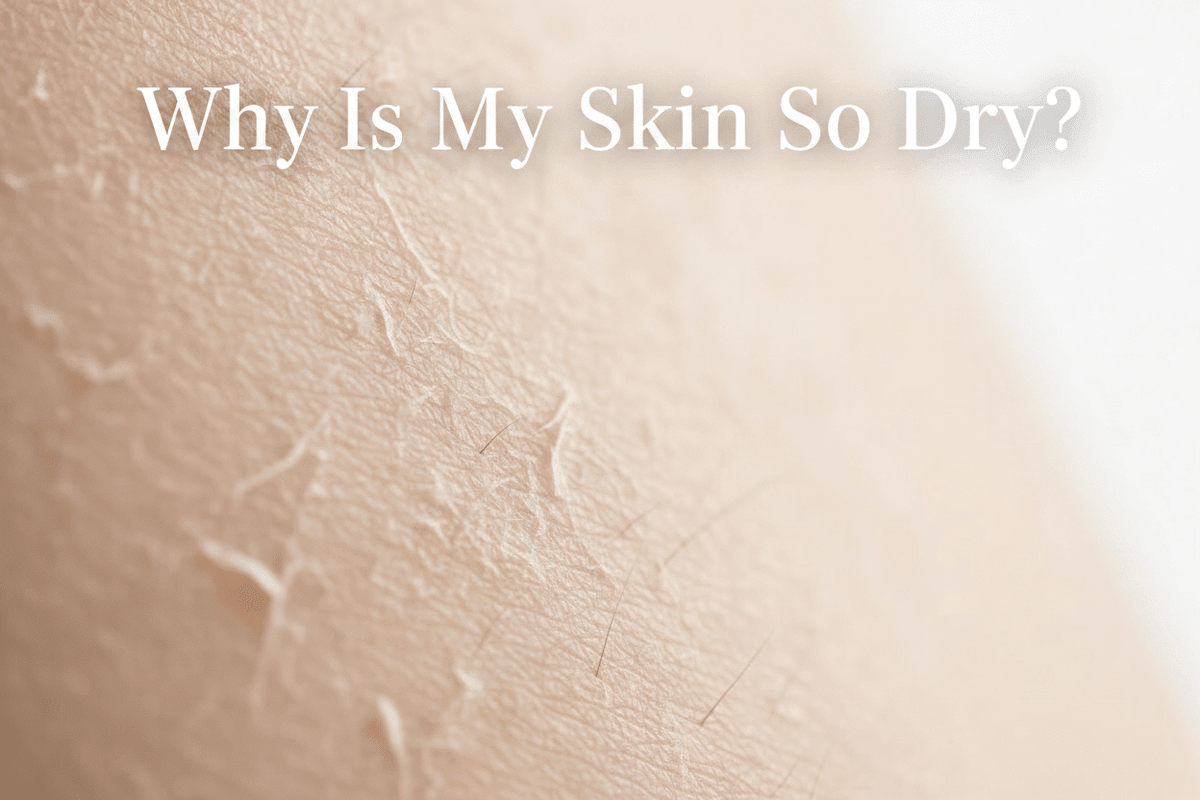
Why Is My Skin So Dry and How Do I Fix It?
Why is my skin so dry even when I’m moisturising? If your skin constantly feels tight, rough or flaky, the problem may be more than simply needing a richer cream.
But persistent dry skin isn’t always a sign that you simply need a heavier cream.
Your skin may be losing moisture faster than it can hold onto it, your cleansing routine may be removing too much of its natural protective lipids, or ingredients in your routine may be making an already vulnerable skin barrier work even harder.
Understanding why your skin is dry is the first step towards knowing what to do about it.
What is dry skin?
Dry skin occurs when the outermost layer of your skin doesn’t have enough water and lipids to function effectively.
Your skin naturally contains substances that help keep it soft and hydrated, while lipids — including ceramides, cholesterol and fatty acids — help form the protective structure between skin cells.
Together, they help reduce excessive water loss from the skin.
When this system isn’t functioning effectively, moisture escapes more easily and skin can begin to feel:
- Dry or rough
- Tight, particularly after cleansing
- Flaky or scaly
- Less soft and supple
- More sensitive or reactive
- Uncomfortable after applying certain skincare
- More noticeable in fine lines
This is why simply adding more moisturiser doesn’t always solve persistent dryness.
Why is my skin so dry?
There isn’t one single cause.
For many people, several factors are happening at the same time.
1. Your skin barrier may be compromised
Your skin barrier is the outer protective layer that helps keep water in and potential irritants out.
Ceramides, cholesterol and fatty acids form an important part of this barrier.
When these lipids become depleted or the barrier is disrupted, transepidermal water loss (TEWL) can increase — meaning more water evaporates from the skin.
Your skin may then feel dry, tight and increasingly sensitive.
A compromised skin barrier can be associated with things such as over-cleansing, excessive exfoliation, environmental exposure and using too many irritating products at once.
Want to understand what’s happening underneath the dryness? Read: Why Your Skin Barrier Matters And: If your skin is already tight, flaky or reactive, read: How to Repair a Damaged Skin Barrier
2. Your cleanser may be too harsh
That squeaky-clean feeling isn’t necessarily a good thing.
Cleansing removes dirt, sunscreen, makeup and excess sebum, but an overly aggressive cleanser can also remove some of the lipids your skin relies on.
If your face regularly feels tight immediately after washing, your cleanser deserves a closer look.
Dry or sensitive skin often does better with a gentle cleanser that cleans effectively without leaving the skin feeling stripped.
Read: Why Does My Skin Feel Tight After Cleansing?
Choosing a cleanser for dry or compromised skin? Read: Gentle Cleanser for a Damaged Skin Barrier: What to Look For
3. You’re exfoliating too often
Acids, scrubs, retinoids and other active ingredients can all have a place in skincare.
More isn’t necessarily better.
Using several exfoliating or high-strength active products together — particularly when your skin is already dry — can contribute to irritation and barrier disruption.
If your skin suddenly becomes dry, flaky or unusually reactive, look at your whole routine, rather than immediately adding another product.
If your routine has become complicated or your skin seems to react to everything, read: Why More Skincare Isn’t Always Better
4. Your moisturiser may not be addressing what your skin needs
Moisturisers aren’t all formulated in the same way.
Some primarily provide hydration. Others focus on emollients or occlusive ingredients that reduce water loss.
For persistently dry skin, it can also be useful to look for ingredients that support the skin barrier itself.
These may include:
Ceramides — naturally occurring skin lipids that contribute to the structure of the skin barrier.
Want to know why ceramides matter for dry skin? Read: Ceramides Explained: What Are Ceramides in Skincare & Why Does Your Skin Need Them?
Panthenol (Pro-Vitamin B5) — a humectant with moisturising and skin-conditioning properties.
Read: What Does Panthenol (Vitamin B5) Do for Your Skin?
Ectoin — helps support hydration and protect skin against environmental stress.
Hyaluronic acid — a humectant that attracts and holds water.
Squalane — an emollient that helps soften the skin and reduce that dry, rough feeling.
Niacinamide — can support normal skin barrier function and ceramide production when used at appropriate concentrations.
If you’ve heard that niacinamide can irritate sensitive skin, read: Does Niacinamide Really Irritate Sensitive Skin?
5. Your environment can make dry skin worse
Sometimes your skincare hasn’t changed — but your environment has.
Cold weather, low humidity, air conditioning, heating, wind and prolonged sun exposure can all affect how much moisture your skin retains.
This is why skin that feels comfortable during one season can suddenly become noticeably drier during another.
Your routine may need to change with it.
6. Hot water isn’t helping
Long, hot showers might feel wonderful, but very hot water can contribute to dryness.
For dry or sensitive facial skin, lukewarm water is generally a better choice.
And after cleansing, don’t wait until your skin feels completely parched before applying your hydrating products and moisturiser.
Why is my skin still dry after moisturising?
This is one of the most frustrating parts of dry skin.
You apply moisturiser. Your skin feels comfortable temporarily.
Then an hour or two later, it feels dry again.
If this keeps happening, the answer isn’t necessarily to keep applying thicker and thicker layers.
Think of your skin barrier a little like a brick wall.
Your skin cells are the bricks, while lipids such as ceramides and cholesterol help form the material between them.
When that structure isn’t working effectively, your skin can have difficulty retaining water.
So while a rich cream may temporarily make the surface feel softer, addressing hydration and supporting the skin barrier can be particularly important for persistently dry skin.
Does a barrier cream need to be thick to work?
Not necessarily.
One of the things I hear from people with very dry skin is:
“I expected a barrier cream to be thicker.”
It’s understandable. When your skin feels extremely dry, a very thick cream can provide that immediate coated, protected feeling.
But how thick a moisturiser feels isn’t a measure of how well it supports your skin barrier.
When I formulated the Peptide Barrier Cream, I didn’t want to simply create the heaviest cream possible. I wanted a moisturiser that could be used consistently while delivering ingredients specifically selected for hydration and barrier support.
The formula combines Ceramides 1, 3 and 6 with cholesterol, alongside panthenol, ectoin, niacinamide, squalane and hyaluronic acid. It also contains Hexapeptide-9 and Palmitoyl Tripeptide-5 to support smoother, firmer-looking skin.
Give your skin time
If your skin has been dry, tight or compromised for some time, don’t expect to apply Peptide Barrier Cream once or twice and have all of that dryness disappear overnight.
You may notice your skin feels more hydrated and comfortable after applying it, but supporting a compromised skin barrier takes consistency and time.
With regular use, the goal is for your skin to gradually feel more hydrated, comfortable and better able to retain moisture — rather than relying only on the temporary feeling of a very thick layer sitting on the surface.
That’s an important distinction.
Peptide Barrier Cream wasn’t designed to simply feel thick. It was designed to support what dry skin actually needs.
If your skin is extremely dry or dehydrated and needs more, this is where I like adding our Restore Cooling Hydrogel Mask.
The mask provides an intensive hydration boost with ingredients including glycerin, sodium hyaluronate, panthenol, hydrolysed collagen and beta-glucan, helping skin look smoother, plumper and more hydrated.
Follow with Peptide Barrier Cream to moisturise and support the skin barrier.
Don’t judge barrier skincare by how thick it feels on day one. Give your skin consistent support and judge it by how your skin feels over time.
Looking for more help choosing a moisturiser? Read: Best Moisturiser for Sensitive Skin in Australia — What to Look For

A Routine for Dry, Sensitive Skin
When skin is very dry, tight or easily irritated, I prefer to think about the routine in stages rather than expecting one moisturiser to fix everything overnight.
The aim is to cleanse without stripping, restore hydration, support the skin barrier and give it time to recover.
Step 1: Cleanse gently
Start with Soft Skin Cleanser, our cream cleanser for dry, sensitive and easily stripped skin.
It gently cleanses without chasing that squeaky-clean feeling and contains squalane, ceramides, beta-glucan and allantoin to support skin comfort.
If your skin is extremely dry, you may only need to cleanse properly in the evening. In the morning, simply rinsing with lukewarm water may be enough for some people.
Step 2: Restore hydration
Follow with Pink Calm Serum
This lightweight hydrating serum combines Vitamin B12, ceramides, niacinamide, panthenol, ectoin, beta-glucan, hyaluronic acid and squalane to help replenish hydration and support the skin barrier.
When skin is dehydrated as well as dry, adding a hydrating serum before your moisturiser can provide an additional layer of moisture without relying on a heavier cream alone.
Step 3: Moisturise and support the skin barrier
Apply Peptide Barrier Cream to moisturise and support the skin barrier.
It combines Ceramides 1, 3 and 6 with cholesterol, alongside panthenol, ectoin, niacinamide, squalane, hyaluronic acid and peptides.
Use consistently morning and evening. If your skin is very dry or compromised, remember that supporting the skin barrier takes time — judge your routine by how your skin feels with continued use, not simply by how thick your moisturiser feels when you first apply it.
Step 4: Add intensive hydration when your skin needs more
If your skin is extremely dry or dehydrated and your moisturiser alone doesn’t initially feel like enough, add Restore Cooling Hydrogel Mask for an intensive hydration boost.
The mask contains glycerin, sodium hyaluronate, panthenol, hydrolysed collagen and beta-glucan to help skin look smoother, plumper and more hydrated.
It can be worn for one hour or overnight, then followed with Peptide Barrier Cream.
This is a combination I particularly like when very dry skin needs additional hydration while you’re consistently supporting the skin barrier.
During the day: protect your skin from UV exposure
Sun protection remains an important part of caring for your skin.
Choose an Australian-approved broad-spectrum sunscreen that suits your individual skin and use it according to the label directions.
If your skin is particularly sensitive or reactive, introduce a new sunscreen carefully. Sunscreen formulations vary considerably, and a product that suits one person’s skin may not suit another’s.
If your skin is particularly sensitive or reactive, introduce a new sunscreen carefully. Sunscreen formulations vary considerably, and a product that suits one person’s skin may not suit another’s.
What should I stop doing if my skin is extremely dry?
If your skin has suddenly become very dry, uncomfortable or reactive, this isn’t usually the time to introduce five new active ingredients.
Consider reducing:
Over-cleansing • physical scrubs • frequent exfoliating acids • multiple strong actives • very hot water • fragranced products if your skin is sensitive
Then give your skin a chance to settle.
Once it feels comfortable again, products can be reintroduced gradually if they’re needed.
Not sure what could be irritating your skin? Read: 10 Ingredients Sensitive Skin Should Avoid (And What to Use Instead).
You may also find The Truth About Fragrance in Skincare helpful if your skin is dry and easily irritated.
Can dry skin cause fine lines?
Dryness doesn’t cause all wrinkles, but dehydrated, dry skin can make fine lines appear more noticeable.
When the outer layers of the skin contain less water, the surface can look less plump and smooth.
Restoring hydration can therefore soften the appearance of dehydration-related fine lines, although it won’t remove established wrinkles.
This is also why supporting hydration becomes increasingly important as skin changes with age.
If you’ve noticed your skin becoming drier with age or hormonal changes, read: Why Has My Skin Changed During Menopause?
When is dry skin more than just dry skin?
Persistent dryness isn’t always a cosmetic skincare issue.
Conditions including eczema, psoriasis and other dermatological conditions can cause dry, flaky or uncomfortable skin.
If your skin is severely itchy, cracked, bleeding, painful, persistently inflamed, developing a rash or isn’t improving, speak with your GP or dermatologist rather than continuing to experiment with skincare.
Skincare can support the skin, but it isn’t a substitute for medical diagnosis or treatment.
Frequently Asked Questions About Dry Skin
Why is my skin extremely dry all of a sudden?
Sudden dry skin can happen for many reasons. Changes in weather, low humidity, air conditioning or heating, a new cleanser, increased exfoliation, retinoids or other active skincare can all affect how your skin feels.
Hormonal changes, including those occurring during perimenopause and menopause, can also affect skin hydration and oil production.
If the dryness is severe, persistent, itchy, inflamed or accompanied by a rash, it’s worth speaking with a healthcare professional rather than assuming skincare is the cause.
What’s the difference between dry skin and dehydrated skin?
Dry skin lacks oil, while dehydrated skin lacks water.
Dry skin is generally considered a skin type, whereas dehydration can affect any skin type — including oily skin.
This means you can actually have oily, dehydrated skin.
Dry skin may feel rough, flaky or consistently lacking in oil, while dehydrated skin commonly feels tight and may show more noticeable dehydration lines.
Read: Dry Skin vs Dehydrated Skin: What’s the Difference?
Why does my dry skin absorb moisturiser so quickly?
If moisturiser seems to disappear and your skin feels dry again soon afterwards, your skin may need more than surface moisturisation.
A compromised skin barrier can allow water to escape more readily, while dehydrated skin may also benefit from additional humectants and hydration underneath your moisturiser.
Rather than simply applying more and more cream, look at your cleanser, hydrating steps and overall barrier-supporting routine.
Why is my skin dry and flaky around my nose and mouth?
Dry, flaky skin around the nose and mouth can have several causes, including irritation, environmental dryness, over-cleansing or products that your skin isn’t tolerating.
However, persistent redness, scaling, itching or irritation around these areas can also occur with skin conditions that require proper diagnosis.
If it doesn’t improve with gentle skincare or continues to return, speak with your GP or dermatologist.
Can a damaged skin barrier cause very dry skin?
Yes. When barrier function is disrupted, transepidermal water loss can increase, allowing more water to escape from the skin.
This can contribute to dryness, tightness, flaking and increased sensitivity.
Barrier disruption isn’t the only possible cause of dry skin, but it’s an important one to consider — particularly if your skin also stings when you apply products or has suddenly become more reactive.
Read: How to Repair a Damaged Skin Barrier
What ingredients are best for very dry skin?
Rather than looking for one miracle ingredient, I prefer a combination.
Ingredients worth looking for include ceramides, cholesterol, glycerin, hyaluronic acid, panthenol, squalane, beta-glucan, ectoin and niacinamide, depending on what your individual skin tolerates.
Humectants help attract and retain water, emollients help soften the skin, and barrier-supporting lipids such as ceramides and cholesterol help support the structure of the skin barrier.
Should I exfoliate flaky, dry skin?
Be careful.
When you can see flakes, it’s tempting to scrub them away. But if the flaking is happening because your skin is irritated or your barrier is compromised, aggressive exfoliation can make the underlying problem worse.
If your skin is also tight, burning, stinging or unusually sensitive, I would focus on gentle cleansing, hydration and barrier support before reaching for another exfoliant.
Why is my skin getting drier as I get older?
Skin naturally changes with age. Sebum production can decrease, and changes in the skin’s structure and ability to retain moisture can contribute to increasing dryness.
Hormonal changes can make this particularly noticeable for some women during perimenopause and menopause.
Read: Why Has My Skin Changed During Menopause?
Can drinking more water fix dry skin?
Staying adequately hydrated is important for your overall health, but simply drinking extra water isn’t usually enough to fix persistently dry facial skin.
If the problem involves your skin barrier, cleansing habits, environment or skincare routine, those factors need to be addressed too.
How do I know if my dry skin needs a doctor rather than skincare?
Dry skin that is persistent, severely itchy, painful, cracked, bleeding, significantly inflamed, developing a rash or interfering with your daily life deserves professional assessment.
Conditions such as eczema, psoriasis and dermatitis can cause dryness but require different approaches.
Skincare can support dry skin, but it shouldn’t be used to self-diagnose or treat an unexplained skin condition.
Related reading:
Dry Skin vs Dehydrated Skin: What’s the Difference?
How to Repair a Damaged Skin Barrier
Best Moisturiser for Sensitive Skin in Australia — What to Look For
The bottom line
If you’ve been asking “Why is my skin so dry?”, don’t automatically assume your skin needs the heaviest moisturiser you can find.
Look at the bigger picture.
How are you cleansing? Are you over-exfoliating? Has your environment changed? Are you supporting hydration as well as the lipids your skin barrier relies on?
For persistently dry skin, the goal is not simply to cover the dryness.
It’s to create a routine that helps your skin hold onto the hydration you’re giving it.
Dry. Tight. Stressed skin doesn’t necessarily need more products. It needs the right ones.
Celulah Skin
Barrier-first skincare for sensitive, reactive and easily overwhelmed skin.
This article provides general skincare information and isn’t intended to diagnose or treat a medical condition. Persistent or significant skin symptoms should be assessed by an appropriately qualified healthcare professional.



Leave a comment
This site is protected by hCaptcha and the hCaptcha Privacy Policy and Terms of Service apply.